DevOps, Day - 70
Terraform Modules

💻 Python | Docker | Jenkins | Networking | Git | Linux 💻
Passionate about leveraging technology to drive efficiency and deliver innovative solutions. Proficient in Python development, Docker containerization, Jenkins automation, computer networking, Git version control, and Linux administration. Skilled in collaborating with diverse teams to deliver high-quality software products. Proficient in AWS EC2 instance management and deployment.
Seeking new opportunities to apply my expertise and contribute to impactful projects. Let's connect and explore how we can work together!
Inter-personal Skills:
Communication, Adaptability, Emotional intelligence, Active listening, Collaboration.
Happy To Connect🔗😊
Feel free to reach me out😃@ --> vrishnishreevb531@gmail.com 📬
Modules are containers for multiple resources that are used together. A module consists of a collection of .tf and/or .tf.json files kept together in a directory
A module can call other modules, which lets you include the child module's resources in the configuration concisely.
Modules can also be called multiple times, either within the same configuration or in separate configurations, allowing resource configurations to be packaged and re-used.
Below is the format on how to use modules:
# Creating a AWS EC2 Instance
resource "aws_instance" "server-instance" {
  # Define number of instance
  instance_count = var.number_of_instances

  # Instance Configuration
  ami                    = var.ami
  instance_type          = var.instance_type
  subnet_id              = var.subnet_id
  vpc_security_group_ids = var.security_group

  # Instance Tagsid
  tags = {
    Name = "${var.instance_name}"
  }
}
# Server Module Variables
variable "number_of_instances" {
  description = "Number of Instances to Create"
  type        = number
  default     = 1
}

variable "instance_name" {
  description = "Instance Name"
}

variable "ami" {
  description = "AMI ID"
  default     = "ami-xxxx"
}

variable "instance_type" {
  description = "Instance Type"
}

variable "subnet_id" {
  description = "Subnet ID"
}

variable "security_group" {
  description = "Security Group"
  type        = list(any)
}
# Server Module Output
output "server_id" {
  description = "Server ID"
  value       = aws_instance.server-instance.id
}

Different Modules in Terraform:
In Terraform, modules are like building blocks for creating and organizing your infrastructure as code (IAC). Think of them as self-contained units that group related resources and their configurations. Modules are a way to abstract, reuse, and organize your infrastructure code. You can create modules for various purposes, such as defining a web server configuration, a database setup, or a VPC (Virtual Private Cloud) layout. Each module encapsulates a specific set of resources and configurations, making your code more modular, maintainable, and reusable.
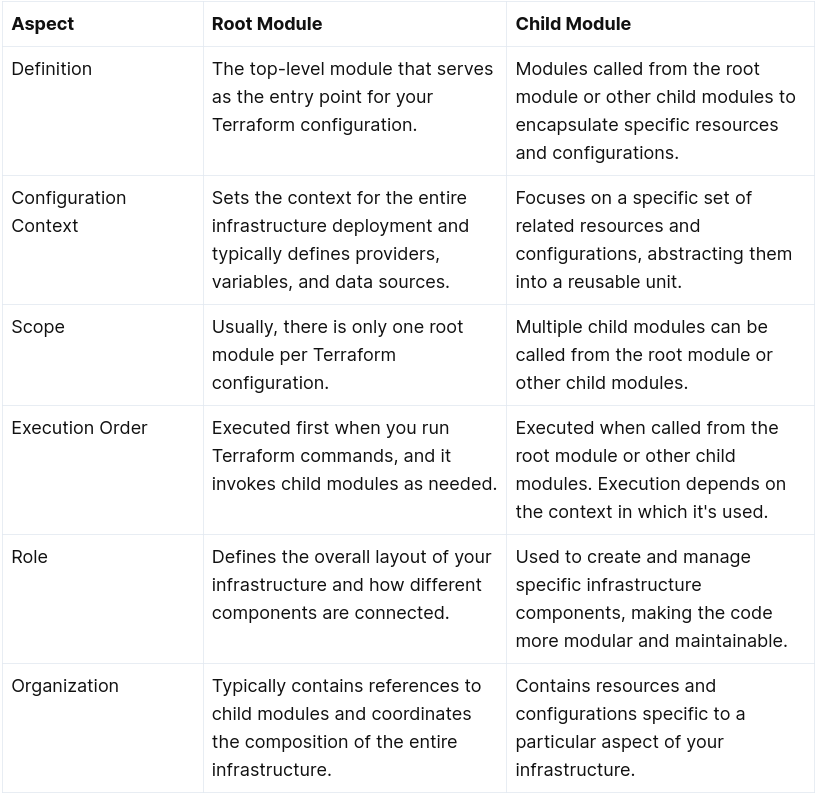
The difference between the root module and the child module:
Modules vs. Namespaces:
No, Modules and Namespaces are not the same.

Thank you so much for reading
Follow me on LinkedIn to see interesting posts like this : )


